








How to Pass the PTE Academic Exam in 5 steps
13 minute read ⌚
How to pass the PTE Academic Exam in 5 steps
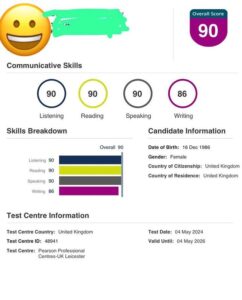
In May 2024, I sat the PTE Academic exam and scored 90 in all areas except writing where I achieved 86. These top tips are things I picked up along the way and learned from my own experience.
- Know the 20 question types
As with any exam, it is key to familiarize yourself with the different types of questions you will come across when you sit the test. This means you will be fully prepared to answer the questions in the real exam and there won’t be any nasty surprises!
SPEAKING AND WRITING
For the Speaking and Writing element of the exam (the longest part), there are 7 different question types. They are as follows:
- Personal introduction – introduce who you are and follow the prompts to describe your hobbies and interests, your reasons for studying the exam and your plans for the future
- Read Aloud – Between 4 and 6 sentences to read aloud. There is time to rehearse the sentence before you then read and record it.
- Repeat Sentence – You will hear a sentence and then immediately repeat it.
- Describe Image – A range of graphs, pie charts and images are presented to you. You have some time to study the image and then 40 seconds to describe what you see.
- Retell Lecture – You will hear a lecture or watch a video. You can make notes on your wipe-clean booklet and then have 40 seconds to summarise the lecture.
- Answer Short Question – Perhaps my favourite part of the test! A short description is provided and you then give a one-word answer or very short phrase.
- Summarise written text – A 250 to 300-word paragraph is presented to you which you have 10 minutes to read and then summarise into ONE sentence. This cannot exceed 75 words.
- Essay – Usually an argument or opinion of some sort which you have to write an essay in response to. This needs to be within 250-300 words.
*******Please take note that there are some changes being made during 2024 to the PTE test. During my exam, I had some additional sample questions (which luckily I was aware of, thanks to watching MilestoneStudy videos on Youtube the day before!) I had to summarise a group discussion and respond to a situation. **************
READING
The Reading part of the exam has 5 question types as outlined below:
- Reading and Writing Fill in the Blanks– A paragraph of text appears and you use a multiple-choice drop-down to select the most appropriate word. I had about 5 of these questions.
- Multiple Choice, Multiple Answer– Read a short paragraph and select the most appropriate answers which summarise the key points or tone of the text.
- Re-Order Paragraphs– Usually 4-5 sentences which need to be sorted to make coherent paragraph.
- Fill in the Blanks– A paragraph appears on the screen with a number of missing words. A selection of missing words, in addition to red herrings, are at the bottom and need to be dragged into the correct position.
- Multiple Choice, Single Answer– After reading the text, you must select the most appropriate answer- mine were mainly summary questions.
LISTENING
Be prepared for this section- people speak quite quickly and you only get one chance to hear each question before responding. A range of dialects are used from English to Australian and Indian.
There are also 8 question types in this section and the time taken to complete these can vary depending on your pace:
- Summarise Spoken Text- Listen to a recording or watch a video and summarise what was said in 50-70 words. You can use your erasable booklet to make notes before doing so.
- Multiple Choice, Multiple Answers- As with the Reading section, you have to select more than one answer. This can be a summary of the main points in the text or the tone which the author conveys.
- Fill in the blanks- Listen to someone speaking whilst the majority of text is on the screen. Fill in the missing words as they are spoken.
- Highlight Correct Summary- You will hear someone talking or watch a video. Once complete, you will choose the answer which summarises the lecture correctly.
- Multiple Choice, Single Answer- Again, similar to that of the reading test, you will listen to a discussion or lecture and select one correct response to the question.
- Select Missing Word- As you listen to someone speaking, you will select the missing words from a selection accurately.
- Highlight Incorrect Words- A person will be speaking and the paragraph will be on screen. However, some of the words they use will be different to the written text. You will need to select these using a highlighter. There are usually 4-5 incorrect words.
- Write from dictation- Whilst the person is speaking, you will need to write down exactly what was said. This is usually only a sentence, although they do vary in length.
- A Little bit of practice goes a long way
I found that rehearsing sections at a time, rather than repeating multiple full mock tests was much more conducive to me. After completing one mock test, I identified my weaker areas and then used a variety of YouTube videos as well as Gurully to revise. See my previous Blog about PTE exam prep. Around 20-30 minutes every other day in the two weeks leading up to my test was sufficient for me.
“Don’t over-prepare or overthink it and you will be fine” was the soundest bit of advice from one of our followers over on Instagram.
- Revise in a noisy space!
The PTE exam room is noisy! Everyone is speaking at the same time and it can be tricky to focus on your answer when you can other people practically shouting theirs! Fortunately, I had heard this before my exam so I tried to revise in a noisy environment with my children around and the TV on so that it wasn’t a shock when I did the real thing!
- Focus on your fluency when speaking
The speaking part of the exam was a really panicky section for me. Remember that PTE exams are marked by a computer system so you are trying to adhere to algorithms, not your use of English!
You have 3 seconds to start speaking after the beep and MUST make sure you do this or you run the risk of getting zero for a question. During your answers, you must not pause for longer than 3 seconds because the computer will think you have finished and will move you on.
Rather than focusing on content, focus on your fluency. Keep speaking until a couple of seconds before the end and make sure you press next, rather than waiting for the computer to time you out and end your answer for you.
Use the templates from Milestone Study for these questions as they did work for me, even though I was very dubious!
- Listen To and Read Instructions Carefully
Before starting to answer a question, make sure you have read and listened to instructions (where provided). It can be really difficult in an exam situation to slow down and take your time, especially when you feel panicked and the questions are coming at a fast pace.
However, understanding what is being asked of you can make a massive difference in your score. Knowing whether you need to select one answer or multiple answers as well as how many words you are expected to write, are all provided in the instructions. Don’t drop marks by not following these. I did on a few of my mock tests, which thankfully meant that on the day, I was ok!


